
HOUSE ON ELGIN ROAD | CHAPTER 1: The Girl at the Gate
To survive the city, she had to kill her name.

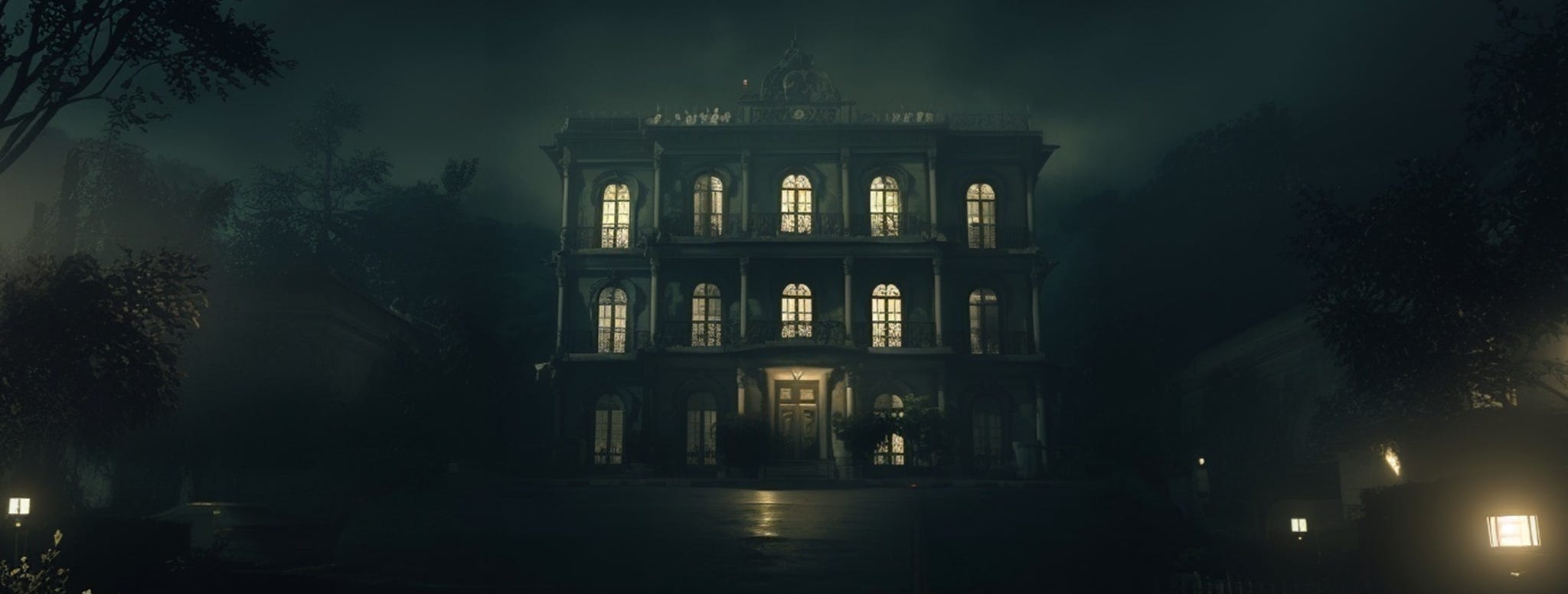
THE HOSTEL
The ceiling fan in Rani’s hostel room cuts through the humid Kolkata air with a rhythmic, dying click. Click. Click. Click.
On her bed, the phone screen glows. It is a video call from home. Madhubani.
“Bas ho gaya, Rani,” her mother says. Her voice is sweet, but it carries the weight of a sentence. “You have had your fun in the city. Three years of college is enough.”
Rani stares at the pixelated image of her mother’s kitchen. It looks smaller than she remembers.
“But Ma, my exams...” Rani tries, her Maithili rusting at the edges.
“Your father has found a boy,” her mother interrupts. “A good family. From Darbhanga. They don’t want a working wife, they want a graduate. You fit. We are sending you the money for the train ticket. Come home.”
The call ends. A notification pings instantly: Rs. 4,000 credited.
Rani drops the phone on the mattress and drops back down flat on it herself. The walls of the shared room seem to shrink. The suffocation hits her like a physical blow—a tight band around her chest. Going back means death. Not a physical death, but the death of everything she has become in this city.
“Bad news?”
Rani looks up. Her roommate, Sneha, is sitting at her desk, the blue light of Adobe Photoshop illuminating her face. Sneha is a graphic designer, cynical and sharp.
“They want me back,” Rani whispers. “To marry.”
Sneha spins her chair around. She looks at Rani, then at the phone.
“So don’t go.”
“With what money? My scholarship ended last month.”
Sneha taps her pen against her chin. “What about that tutoring agency? The one in Bhawanipore. You said they pay cash.”
Rani laughs, a bitter, dry sound. She picks at a loose thread on her worn kurta.
“I went there yesterday. They don’t hire girls like me for the high-end clients.”
“Why? You’re a topper.”
“It’s not about marks. It’s about the packaging,” Rani says, her voice tight. “For the mansions on Elgin Road, they give preference to ‘cultured’ Bengali women. Gariahat types. Convent educated. They hear ‘Madhubani’ and they think ‘maid’. They don’t want a tutor, they want a status symbol.”
Sneha stops tapping the pen. She looks at Rani, really looks at her. Then a slow, dangerous smile spreads across her face.
“I’m a graphic designer, Rani,” she says softly. “I can fix the packaging.”
“What?”
“I can make you a perfect Bengali girl. A degree from Calcutta University. I can print a resume that smells like old money.”
Rani stares at her. It’s a fraud. It’s a trick. It’s a lifeline.
“What do you want?” Rani asks.
Sneha points to the phone. “The 4,000 rupees your father just sent. That’s my fee for the design work.”
Rani looks at the money, this is basically her ticket home. Then she looks at Sneha.
“Do it,” Rani says.
Sneha calmly operates photoshop as she replaces Rani’s surname from her Class 12th certificate from Rani “Kumari” to Rani “Banerjee”. Rani looks on nervously.
THE STREET
Two days later.
Elgin Road is not just a street; it is a timeline. The further you walk, the further you leave the chaos of modern Kolkata behind, entering a silence bought by old money.
Rani squeezes herself against a damp wall to let a black Mercedes pass. She is muttering under her breath, not a prayer, but a rehearsal.
“Rani Banerjee, Gariahat” she whispers. She rolls the ‘R’, polishing the rough edges until they sound like smooth porcelain.
She stops in front of the gate. It rises like a border crossing, iron spikes against a grey sky.
The security guard steps out. He scans her. He sees the cheap sandals, the nervous hands.
“Delivery is from the back side,” he grunts.
Rani straightens her spine. She remembers the 4,000 rupees she gave away. She has no money to go back. She has to go forward.
“I am here for Mrs. Vardhan,” she says. She switches to the clipped, arrogant tone of a city tutor. She drops the name of a prestigious coaching center like a coin onto a table.
The guard pauses. The suspicion in his eyes softens just enough. He buzzes the gate.
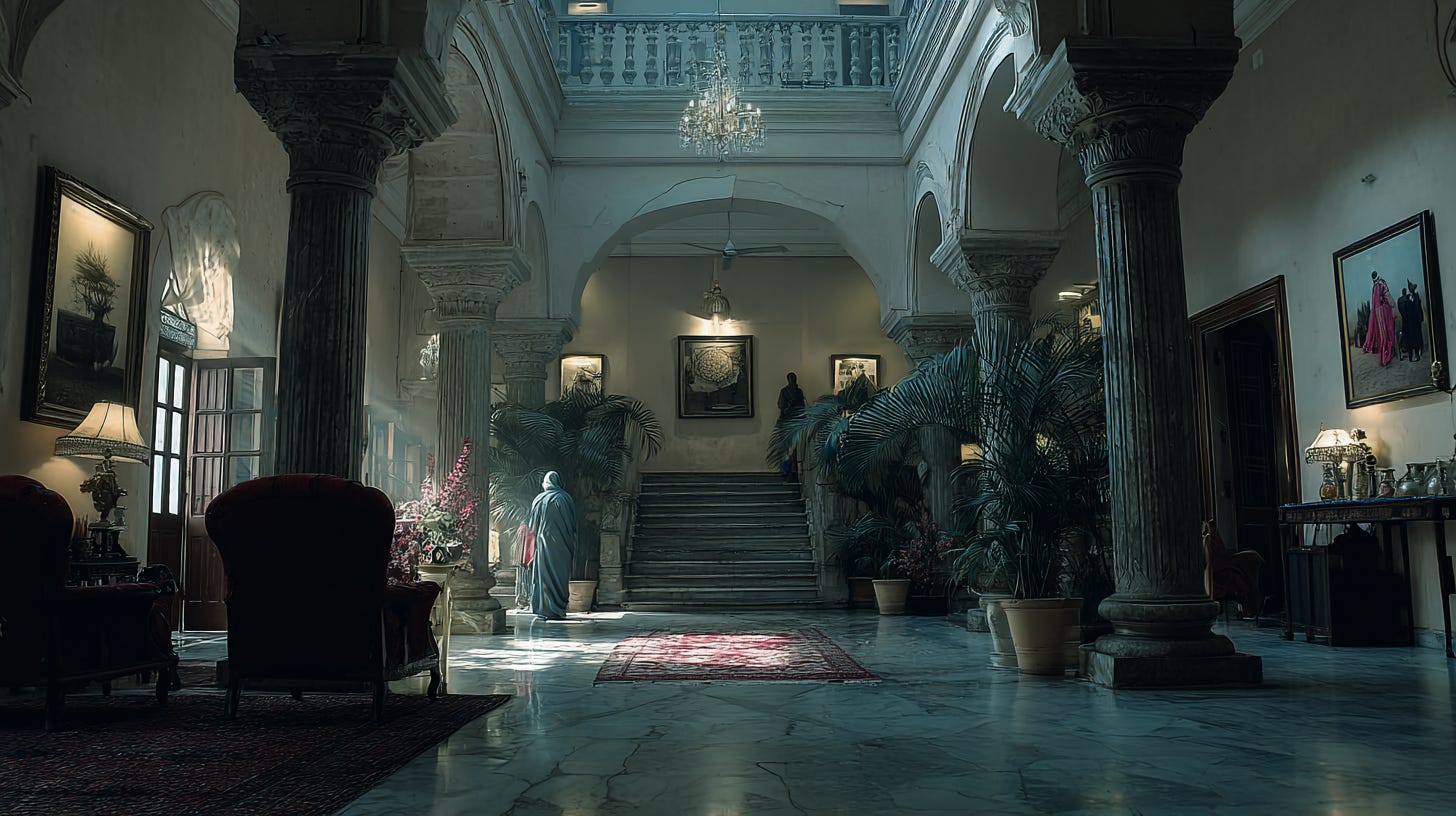
THE INTERVIEW
Inside, the silence is heavy. Pramila, the head housemaid, leads her through corridors lined with unblinking CCTV cameras.
Rani sits in a waiting room inside the Vardhan Mansion. The room is massive: bigger than her entire hostel floor, but the silence makes it feel small. Rani stares at her knees, rehearsing the lie in her head.
She scrubs Bihari off her tongue, syllable by syllable. She is terrified that if she opens her mouth, her accent will betray her.
The heavy teak door creaks open. Pramila, looms in the doorway.
“Madam bula rahi hai.” Madam is calling.
Rani straightens her spine. She takes a breath that goes all the way down to her stomach, and walks in.
If the waiting room was big, the main living room is a cathedral to old money. The air is freezing cold, smelling of expensive polish and absolute power. Expensive paintings line the walls, art that costs more than Rani’s entire village earns in a year.
In the center of the room, on a high-backed velvet sofa, sits Sunita Vardhan. She looks like a statue carved from ice.
Rani sits across from her. The glass center table feels like a minefield.
Sunita holds Rani’s forged certificates in her manicured hands. She doesn’t look up.
“Where in Gariahat do you live?”
Rani answers smoothly, just as she practiced. “Ma’am, in the lane behind Adi Dhakeshwari Bastralaya.”
Sunita stops reading. She looks up. Her eyes are sharp.
“Do you know Kishore Bhowmik? He runs a garment business in that same lane.”
Rani’s heart hammers against her ribs. It’s a trap. A local test. She is sweating under her clothes, but she keeps her face completely still.
“No, Ma’am,” Rani says softly. “Perhaps... perhaps my Baba knows him.”
Sunita narrows her eyes. “Is that so? How long has your father...”
The sound of the door opening interrupts the inquisition.
Aditya enters. Eighteen years old, draped in expensive casual wear, looking bored out of his mind. He walks in, glances at Rani, and his eyes drop immediately to her feet.
Rani curls her toes. She realizes too late, her socks. They are cheap, slightly worn at the ankles.
Aditya slumps onto the sofa and pulls out his phone. He says in a low voice towards his Mother.
“She won’t last.”
Rani freezes.
Sunita ignores the comment. She turns to her son. “Did you finish your SAT essay? The submission was tomorrow.”
“Mom, please,” Aditya groans, not looking up from his screen. “I don’t want to do this. I wrote it... but they said it needs to be better.”
Sunita sighs, a sound of elegant exhaustion. “What did you write about?”
Aditya scrolls to a document on his phone and reads in a monotone voice: “I want to help solve the silent hunger of the street children...”
The room goes quiet.
Rani knows she should stay silent. She knows she should be invisible. But the pretension of the line, the lie of it, irritates her more than the fear.
“That line doesn’t sound lived-in, Sir,” she says.
Aditya stops scrolling. He slowly lowers the phone. He looks at her, really looks at her, for the first time.
“Excuse me?” he scoffs. “And how would you write it then?”
Rani looks him straight in the eye. She drops the mask.
“Hunger isn’t silent, Sir,” she says. Her voice is steady, perfect English. “It is loud. And when you haven’t eaten for days... it is the only thing you can hear.”
Pin-drop silence.
Aditya stares at her. He blinks, stunned. Then, without a word, he types the sentence into his phone.
Sunita watches the exchange. She looks at her son’s reaction, then back at Rani. She closes the file on her lap.
“You can start tomorrow.”
Rani feels a surge of adrenaline. She wants to jump, to scream, but she forces a polite nod. “Thank you, Ma’am.”
She stands up to leave. She is almost at the door when Pramila’s voice stops her.
“And listen.”
Rani turns. Sunita is watching her with a look of terrifying assessment.
“When you are in this house... try to blend in.”
Rani gives a short, tight smile. She nods.
As the heavy door clicks shut behind her, Rani exhales.
THE COURTYARD
Rani steps out of the living room and into the corridor that wraps around the central courtyard.
And there, she stops.
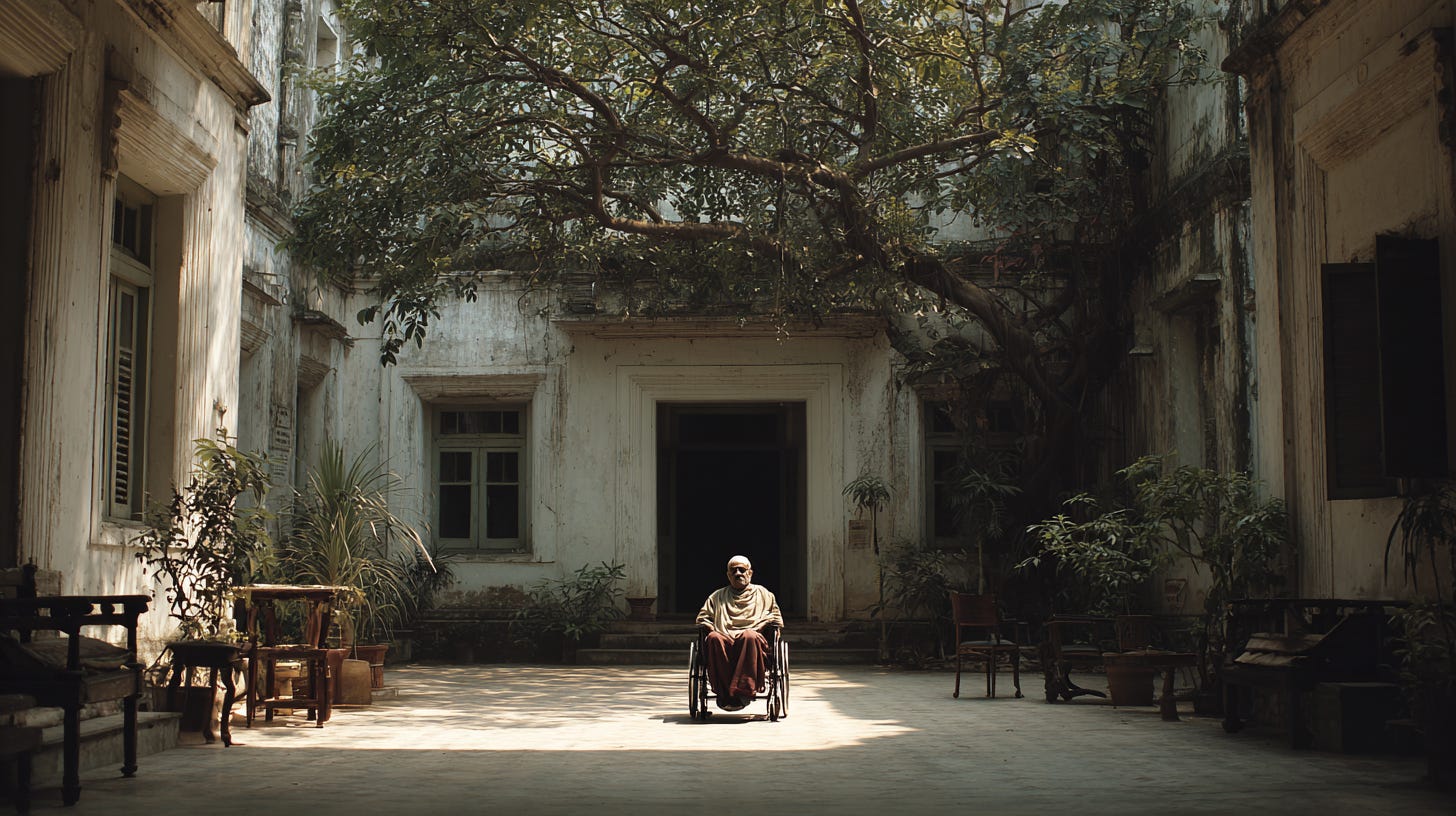
In the center of the open-air courtyard, under the shade of a neem tree, sits an old man. Bauji. The Grandfather.
He is in a wheelchair. He isn’t looking at the sky or the birds. He is staring with absolute, unblinking focus at a blank spot on the white plaster wall.
He doesn’t move. He doesn’t even seem to breathe. Yet, his stillness feels heavier than the antique furniture around him.
Rani shivers, though the air is warm. She hurries past him, desperate to reach the exit.
THE EXIT
She reaches the main hallway.
“Wait.”
It is Pramila, the head housemaid. She is standing by a pillar, arms crossed, watching Rani with cold, dead eyes.
“Servants use the side door,” Pramila says. She points to a narrow, dark corridor that leads away from the grand entrance. “The main gate is for Family.”
Rani swallows her pride. “Of course.”
“If you need anything ask me.. And yes.. No one is allowed to go to Ground Floor Western Wing.” Rani says “Yes”.
She turns toward the side corridor. But as she does, the front door swings open.
The air in the hallway seems to drop ten degrees.
A man enters. Vikram Vardhan.
He is in his fifties, wearing a crisp white kurta-pyjama that looks brighter than anything else in the room. He doesn’t look angry. He doesn’t look violent. He looks completely, terrifyingly calm.
The silence that falls over the house is instant. Even Pramila, who looked so imposing a second ago, shrinks back against the wall, bowing her head.
Vikram stops. He is peeling off his sunglasses.
He notices Rani standing in the middle of the hallway.
He doesn’t ask who she is. He doesn’t frown. He simply stops moving and looks at her.
It lasts for only three seconds. But in those three seconds, Rani feels something she didn’t feel with Sunita or Aditya. She feels x-rayed. It is a look of total, brutal assessment.
Then, without a word, he looks away. He walks past her, his footsteps silent on the marble, and disappears up the grand staircase.
Rani forgets to breathe. Her heart is hammering against her ribs like a trapped bird.
Pramila steps forward, her voice a harsh whisper. “Go. Now.”
Rani doesn’t argue. She rushes down the side corridor, pushing past the heavy service doors, stumbling out into the humid, noisy heat of Elgin Road.
She looks back at the mansion. It looms over the street, silent and massive.
Instagram did the job ,I came here after the reel can't wait to read all the other pieces 🙌🏻
Its captivating! Can't wait for the next one